
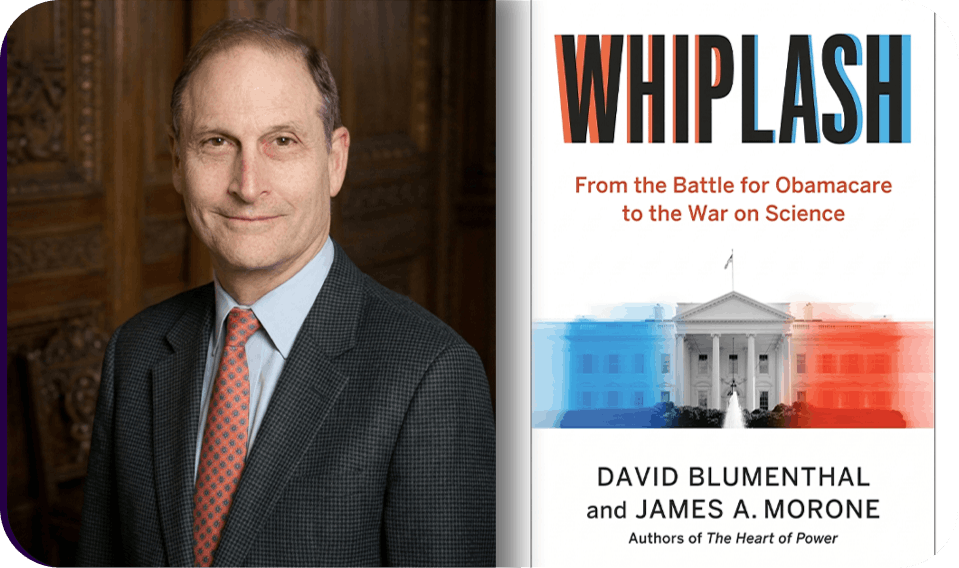
The Carol Emmott Foundation recently had the chance to sit down with Dr. David Blumenthal, physician, healthcare policy expert, and chairperson of the Foundation’s governing board. In this interview, edited for length, Dr. Blumenthal discusses his latest book, Whiplash: From the Battle for Obamacare to the War on Science, co-authored with James Morone.
The book explores the continual shifts and moral divides that shape American healthcare and public policy. Drawing on both professional expertise and personal experience, Dr. Blumenthal explores how presidential administrations, along with powerful incentives, have shaped policy and swayed public opinion.
Interviewer: Carol Emmott Foundation – Doug Riddle, Curriculum Director
Interviewee: Dr. David Blumenthal, Former President of The Commonwealth Fund; Professor, Practice Public Health Harvard Chan School of Public Health; Chair of The Carol Emmott Foundation Board of Directors
Introduction
Carol Emmott Foundation:
I’m here today with David Blumenthal, well known to the Carol Emmott community as chair of our governing board. He is an academic physician and healthcare policy expert who served from 2009 to 2011 as the National Coordinator for Health Information Technology under the Obama administration.
David has written a second book with James Morone, professor of political science and public policy at Brown University. Their first book, The Heart of Power, examined how presidents’ personal experiences with health and loss shaped policy. Their new book, Whiplash: From the Battle for ObamaCare to the War on Science, explores a very different and more turbulent era.
David, I’ll start by saying I often avoid policy books—they can feel like trying to move a mountain with a teaspoon. But this book is brisk, lively, and accessible. It should appeal well beyond policy experts.
Let’s begin with what led you and James to connect the battle over the Affordable Care Act with the rising antipathy toward science.
From Health Policy to “Whiplash”
David Blumenthal:
We didn’t plan that connection. We began the book before the pandemic, intending to focus on the Affordable Care Act, cost control, and traditional healthcare issues.
But as the pandemic unfolded, it became impossible to ignore its broader consequences—declining trust in science, public health, and vaccines. The more we examined it, the more it felt like a “whiplash” moment: a sharp shift away from a century of healthcare debates into something entirely new—conflicts over the culture of health itself, and whether experts are a kind of tyrannical elite.
That discontinuity is really where Whiplash came from.
There was also the contrast among recent presidents. You begin with a charismatic, intellectual, Black leader who symbolized diversity. He’s followed by someone very different—anti-elitist, opposed to diversity, with a very different communication style. Then comes Joe Biden, more of a government technician whose strength lies in understanding how institutions work.
That dramatic shift in leadership styles reinforced the idea of “whiplash.”
Reframing the Book
Carol Emmott Foundation:
That reframing really changes the arc of the book.
David Blumenthal:
It does. And for me, as a physician, diving into pandemics was eye-opening. I’m not an epidemiologist, so I had to learn in real time. It was so illuminating that I now teach a course on presidents and pandemics.
On Research and Appendices
Carol Emmott Foundation:
One thing I appreciated was how you “show your work”—especially the appendices with background studies. What led you to include those?
David Blumenthal:
We were very aware of the “moving mountains with a teaspoon” problem. We wanted the book to move quickly and avoid getting bogged down in technical detail.
The appendices let interested readers go deeper without interrupting the narrative flow.
Moral Divides in American Healthcare
Carol Emmott Foundation:
One of the most powerful parts of the book is your analysis of value differences between Democrats and Republicans. You write that their views “rest on profoundly different moral principles.” Can you elaborate?
David Blumenthal:
This is where my co-author Jim Morone’s work is especially influential. At its core, the divide reflects a tension between libertarianism and communitarianism.
In much of Europe, there’s an assumption of shared responsibility—a sense that society collectively supports the sick and vulnerable. In the U.S., many people believe that individuals should keep what they earn and bear responsibility for their own circumstances.
As a physician, I struggle with that view. Illness often isn’t the result of personal choices. People get sick through no fault of their own—accidents, cancers, genetic conditions. The idea that individuals should bear the full cost of illness doesn’t align with clinical reality.
There’s also a deeper question about freedom. One view—associated with FDR—is “freedom from”: freedom from want, illness, insecurity. The other is “freedom to”: the right to act without constraint, regardless of broader consequences.
That tension underlies much of our political division.
Pandemics and Collective Responsibility
David Blumenthal (continued):
Pandemics make this especially clear. Vaccination, for example, is not just a personal benefit—it’s a societal one. But that idea has been difficult to communicate.
School closures during COVID illustrate this. Children weren’t severely affected, but they transmitted the virus. Closing schools wasn’t just about protecting them—it was about protecting everyone they interacted with. That requires seeing society as a community, not just a collection of individuals.
Incentives in the Insurance System
Carol Emmott Foundation:
You describe a core principle of the American insurance system as “seek the healthy, shun the sick.” Can you explain?
David Blumenthal:
In an unregulated market, insurers aim to collect more in premiums than they pay out in care. That difference becomes profit.
But if you insure many sick people, your costs rise—what’s called the “medical loss ratio.” So insurers are incentivized to avoid high-risk individuals through underwriting.
That’s why, historically, people with pre-existing conditions were excluded or charged more. Without regulation, many of the people who most need insurance are effectively pushed out.
What the Affordable Care Act Changed
David Blumenthal (continued):
The Affordable Care Act addressed this by setting guardrails. It prohibited most underwriting, required insurers to cover high-risk individuals, and standardized benefits.
President Obama also accepted a key political reality: the government wasn’t going to eliminate private insurance. So the question became how to make that system work more fairly.
The ACA said: you can participate, but you must follow rules that make insurance function as insurance—covering risk rather than avoiding it.
Women and the Implementation of the ACA
Carol Emmott Foundation:
You highlight that women led the implementation of the ACA. What stood out about their leadership?
David Blumenthal:
Nancy-Ann DeParle, Jeanne Lambrew, and Liz Fowler were central figures. All three were deeply experienced—there was no on-the-job learning required.
One factor may be that women are often only given these roles once they’ve clearly proven themselves. They brought deep expertise, strong interpersonal skills, and extraordinary drive.
More broadly, healthcare is increasingly a female-dominated field, and leadership is reflecting that.
Are We Prepared for the Next Pandemic?
Carol Emmott Foundation:
You note that COVID killed over a million Americans—nearly as many as all U.S. war deaths combined. What will it take for us to prepare for the future?
David Blumenthal:
It will take leadership—a president who understands the stakes and is willing to act.
George W. Bush and Barack Obama both made significant efforts after facing threats like bioterrorism, H1N1, and Ebola. But today, the word “pandemic” itself has become polarizing.
In fact, we are less prepared now than we were before COVID. We’re underfunding public health, not investing in vaccine development, and dismantling preparedness systems.
What I came to understand is that pandemics are not just health issues—they are national security issues. We spend trillions preventing terrorism, yet pandemics have had far greater societal impact.
A Cultural and Gender Lens
David Blumenthal (continued):
A poet friend pointed me to pandemic literature, especially from 1918. Much of it was written by women. Men were writing about war; women were writing about illness.
That reflects a broader cultural pattern: men as warriors, women as caregivers. Our institutions reflect that bias—we invest heavily in military defense but comparatively little in public health.
Closing Reflections
Carol Emmott Foundation:
This book makes a compelling case that health is not an individual issue—it’s collective. Disease doesn’t stop at your door.
Thank you, David, for this conversation. We look forward to the book’s impact.